 St. Angela’s Children’s Hospital — Reggie’s
Like all big University Teaching Hospitals, St. Angela’s has a busy children’s hospital on its campus. These places are usually separated from the main building in special ways — the age of its patients; the culture, look and feel of the place; and how its systems work. At St. Angela’s, to its rear, away from the river, you will find a fenced off area where the vibrant colours and the sound of children playing in the courtyard greet you. You often forget to look down as you rush to the main entrance and stumble over the toys and small furniture that litter the place.
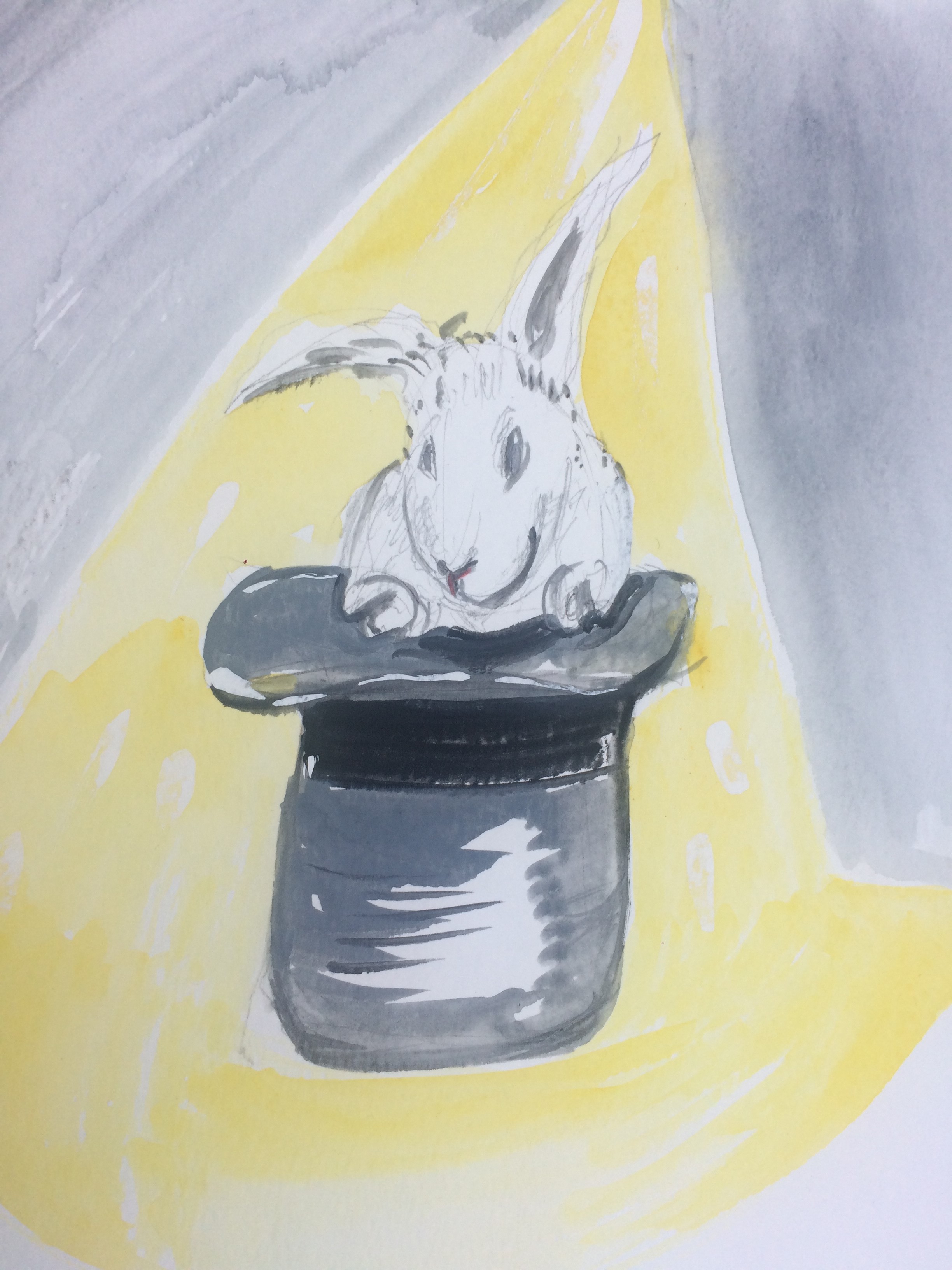
Illustration by Bill Morris
As with most hospitals, St. Angela’s had a competition to name this special place as Reggie’s after the big white rabbit of that name, jumping out of a fine top hat.
There was much excitement when Alex, our weary Chief Executive, had been called to a meeting with a film star. St. Angela’s was to be awarded a fabulous endowment for a new building for Reggie’s from the man of the movies whose own child had been saved by the wonderful doctors and nurses there. As with all these things, the money was not quite enough for the hospital’s ambitious plans so a fund-raising committee was set up. They also launched a design competition involving world-class architects and environmental specialists as St. Angela’s wanted to lead the way in all things “green”. Alex needed a steering committee involving senior staff, children, and of course the local posh ladies who formed “the Friends”.
As things progressed, the medics got agitated. They wanted a MAC — Medical Advisory Committee — to make sure the new designs worked for clinicians. Not to be outdone, the architects, designers and ergonomics specialists had their design committee, with a children’s representative on it. Alex, with a growing sense of losing control, appointed a financial control and project management committee to pull everything together. So there we have it, five committees all happily designing and organising things for a new glittering hospital, in separate rooms.
Meanwhile, everyday life at Reggie’s progressed. Alex had to deal with complaints from the junior doctors, the residents, who felt their training was inadequate as their seniors “couldn’t teach.” The nurses, labs and pharmacy staff were crawling up the walls in frustration as the senior doctors recognised no rules or procedures and did as they pleased. The eternal disputes about car parking, especially for the senior medics, pounded like a constant drum in Alex’s crowded head. And then the hospital ran out of nappies. The supplies department had introduced a new computerised stock system and it got the numbers wrong, by three decimal places.
Exhausted, Alex, while trying to keep five committees going for the new build, asked his trusted long-serving Director of HR (Human Resources) and OD (Organisational Development), Sue, to handle the disputes. She concluded that the children’s hospital needed some “OD”. And, maybe, a strengthening of its management systems. She had been on a course which taught her about the wonders of a then new fangled management device from America called “MBO” — Management By Objectives.
From Psychopaths to Prima Donnas
Over the years, I had specialised in flushing out psychopaths. It was trying work, and depressing. My dear old mentor and teacher, the Prof, had warned me many years ago not to be so narrow so I jumped at the chance of working on the problem of Prima Donnas. Their behaviours are often confused with those of psychopaths. Indeed some seem to overlap but there is one crucial difference — Prima Donnas are not malicious. They are emotional and have empathy, unlike psychopaths.
The prima donna is of course the first, leading, lady in the opera who is central to the plot. Everything revolves around her — the other characters, the sets, the score. She carries the narrative and the plot. She is the essential person in the show and she and everyone else, knows it.
Prima Donnas have built up a reputation for a set of behaviours that now describe a type of personality that is sometimes seen in other organisations. They are recognised as being “difficult” but essential. They can be obnoxious and vain. They can have grand personalities which are demanding. And they can be temperamental and have an inflated opinion of themselves.
Organisational Prima Donnas are usually men so we should really refer to them as Primi Uomini, but we don’t. We say they exhibit “Prima Donna” behaviours and attitudes. However, they are critically important skilled people upon whom the organisation is totally dependent, so their behaviours are tolerated. They do not sit well in big bureaucratic organisations — a bit like oil and water, they never mix. St. Angela’s had its Prima Donnas, especially in the children’s hospital.
Dr. St. Clair was one of Reggie’s senior doctors. He did his own thing, always. He thought rules and management were boring and tedious, and nothing to do with him. He swanned in, looked serious and behaved in a pompous manner, and didn’t even notice the staff around him. The parents and children loved him. Dr. Anderson; he was a case — another Prima Donna who thought he was royalty. And then there was Dr. Van der Loo, the senior resident, who had been schooled by his two consultants in Prima Donna ways. All three were on the “MAC”.
Life at the Western Theatre
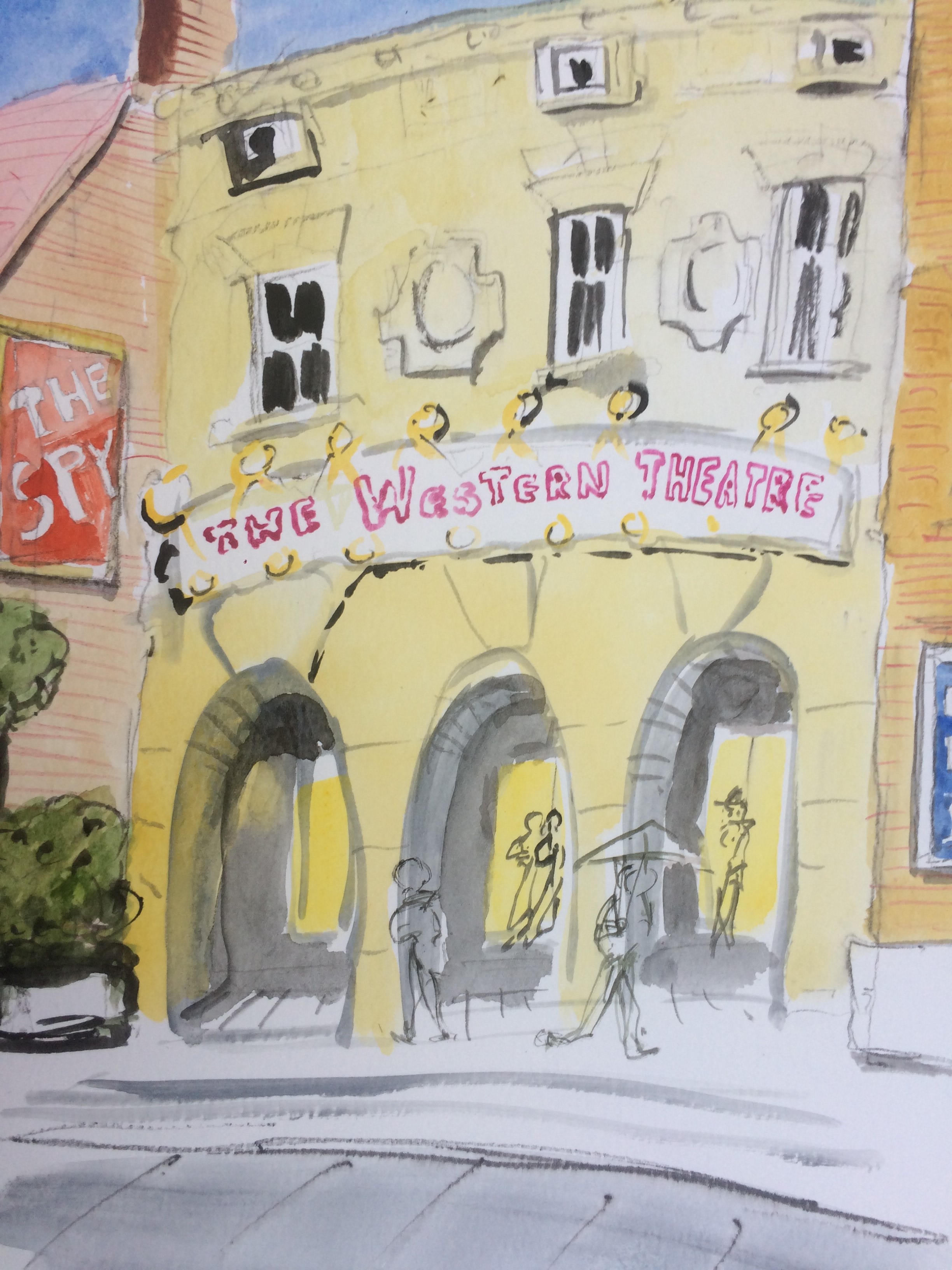
Illustration by Bill Morris
Trying to make sense of the tangle of events at Reggie’s, I cast my mind back several years. On secondment to the Western Theatre, I quickly learnt that this organisation, like all theatres, was stuffed full of Prima Donnas. To show commitment, I moved to the pretty town in the west of the country to work for the Director of HR and OD, Debs, for a year. The theatre was relatively wealthy being in receipt of a government grant as well as having a financial cushion from its many patrons, benefactors and customers. Being young and naive, I thought these places were straightforward — you worked on a play, you sold the seats and you put on a show. How wrong I was — theatres are extremely complex enterprises where they really do try to mix oil, the creatives, and water, the bureaucrats.
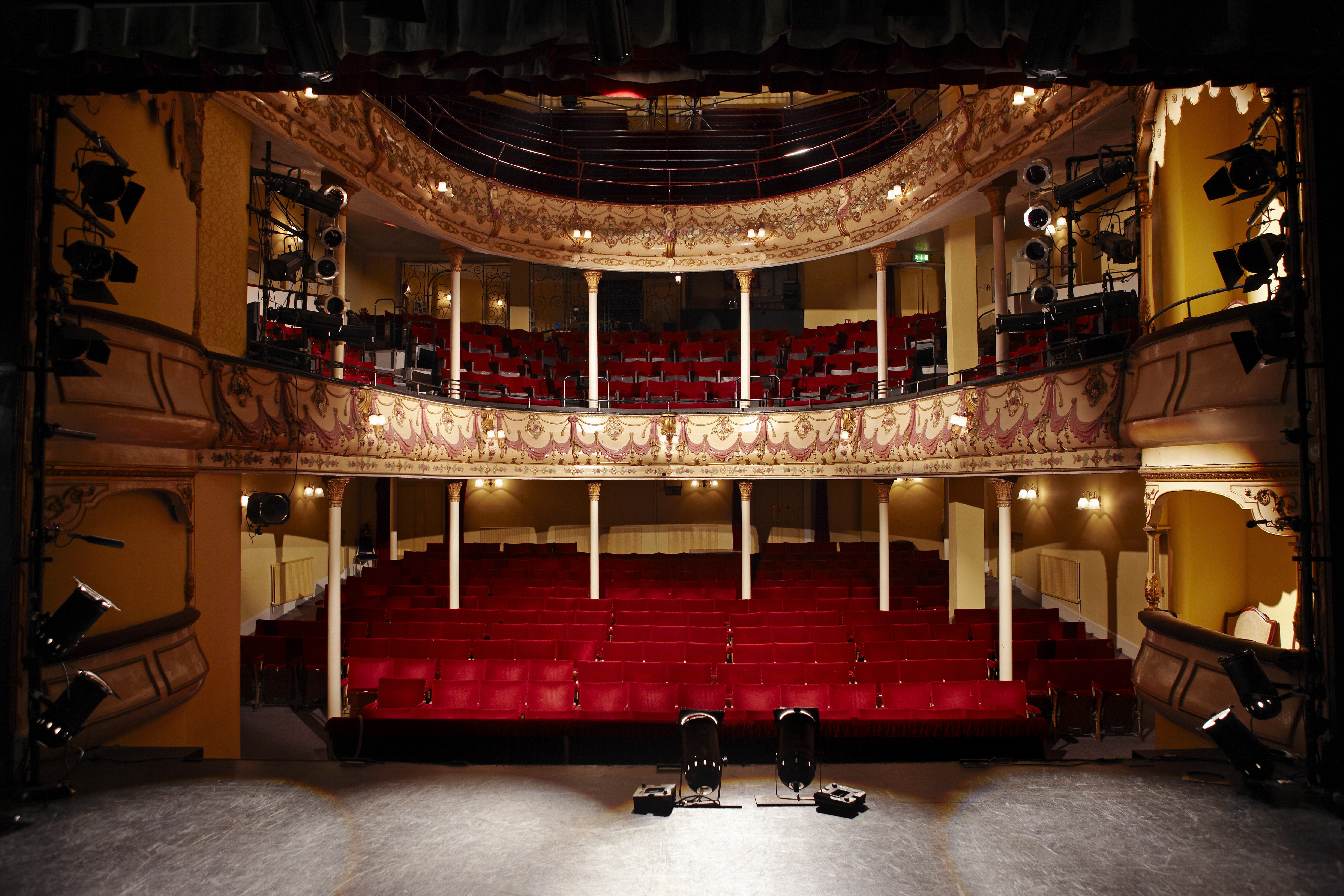
Debs was an energetic go-getting boss who loved the theatre, and the Western Theatre was a good historical building to love. It stood in the centre of town with its porticos leading to the main doors offering a warm welcome to all comers. Inside, it had the usual racks of red plush seats, and balconies and upper tiers trimmed in gold paint. It looked and felt sumptuous. But behind the big claret curtains, it was a different story backstage where it was very cramped, sparse and undecorated.
 Debs taught me a lot about the problem of mixing creatives with bureaucrats, as best as you can, and about dampening the worst aspects of Prima Donnas. She organised an induction programme for me so I could get a fix on all the parts of the theatre. And she told me about the theatre’s golden rule: you never stare at the actors, especially the famous ones. It was a wonder to me as I learnt about how a play was selected, and then deconstructed and reworked into jobs lists for set designers, costumiers, musicians, lighting and sound engineers, and movement and speech specialists. Having done all that, the stage managers then organised the tedious print runs of the scripts, scheduled the rehearsals and coaching sessions, and orchestrated the pieces coming together on a strict timetable ready for “opening night.”
I really felt like Clara in the Nutcracker ballet as she was shown around the Kingdom of Sweets by the Sugar Plum fairy, Debs in this case. The “creatives” looked to the Artistic Director for their lead, who selected the plays and the producers. The producers selected their own set and costume designers who were all brought in uniquely for each play. It was they who then created the work for the theatre’s staff — the set builders and costume-makers. It was all about who knew who and had worked together before. Producers and designers had their favourites, and the theatre’s more humble staff had no choice — they just had to get on with it.
And then behind the scenes there was the bureaucratic machinery of scheduling and paying for all this activity. There was the usual management structure to keep the building going and cleaned; the people fed and watered; and the seats sold and paid for. There was the “front of house” team who greeted the public; the marketing and sales team that generated the sales; and the finance and accounts team that counted up the money and banked it after each performance. This important enterprise was run by a general manager who had to keep it all going while the “creatives” bobbed in and out according to their schedules. And then the actors arrived.
Behind the Curtain, Disputes Galore
So I learnt very quickly that the perfect show that the public sees and experiences each night is based on a seething mass of frenetic activity and tension that by some miracle comes together despite all the difficulties. Well, you can imagine the tensions bubbling up into disputes and there were plenty of them. So in pupillage to Debs, I learnt to work on such disputes and with the many Prima Donnas who floated above the fray even when they had caused it. The critical point here is that no theatre would tolerate Prima Donna behaviour if such individuals were not central to the show’s success.
As I look back, my time at the Western Theatre was great experience for dealing with the precious creatives at St. Angela’s.
 In the Kingdom of Sweets, the first dance is by the hot-blooded and excitable Spanish dancers who burst onto the stage and move quickly through their tarantella. They reminded me of the individuals in the costume department dispute. Much fretting was generated in management by these “creatives” who broke all the rules as they sought perfection on their terms. They didn’t recognise budgets as they fell over themselves to please the costume designers. It was the Head of Costumes’ job to rein them in.
Back in the Kingdom, the Arabian dancers follow the Spanish. In complete contrast to the opening piece, their dance is slow, purposeful, concentrated. Each dancer must work with the others in complete harmony as they pass the ballerina aloft between them while she moves hypnotically to the sonorous sound of the oboes and pipes. They reminded me of the stage managers’ dispute which caused the general manager many sleepless nights. This group must work in a synchronised harmonious way as they are the emulsifying agent between the oil, the “creatives”, and the water, the bureaucrats. It was Debs’ job to arbitrate the dispute while keeping the creatives and the bureaucrats calm.
And finally, in the Kingdom, the Russian dancers exhibit an unbelievable level of fitness in their rapid Cossack-style standing and crouching routine while kicking their legs out with their arms folded at chest level. They have to be perfect in their timing. They reminded me of the musicians’ dispute which caused the actors much anxiousness. The Music Director had been asked to improve the musicians’ discipline and performance as some of the actors had complained about being drowned-out by early entries. There was even a rumour that the drummer drank too much before a performance.
Working with Debs, I learnt about the tensions within and between the “creatives” and the bureaucrats. They exist in the same world, but at the same time, very different worlds. Neither really understands each other, but they have leant to tolerate that which is a mystery to them. I also learnt about how crass some interventions by outsiders can be in disrupting the delicate balance. For example, some bright spark in the government (who did give the theatre a grant of public money) thought that introducing “MBO” in public theatres would be good for accountability. Anyone who has worked with Prima Donnas knows that this is a recipe for disaster.
Back at St. Angela’s, the Committees have fallen out
Back at St. Angela’s, predictably, the five committees for the new build had fallen out with each other. Alex just wanted it all to work better. Sue just wanted some “OD” and performance management. The MAC wanted “action,” and to be the centre of all decision-making. And the posh ladies on the steering committee had designed a lapel badge to make everyone feel part of the same team for Reggie’s. They got upset when the fund-raising committee pinched their work to support the fund-raisers.
The most important committee in Alex’s eyes was the finance and project management committee. He related best to these accountants and controllers. As far as he was concerned, they spoke sense and had a (kind of) grip on the situation. They were an entertaining bunch. They called the steering group the “bunny club” because the lapel badge they designed consisted of a white ball of fluffy stuff with two ears sticking out of the top. They called the architects, designers and ergonomic committee the “spacemen” — very funny; and they identified the MAC members as Prima Donnas.
How do you make a new hospital out of all that? Let’s see if the experiences in the Western Theatre’s disputes can help us.
 Old Lady by the Sea