My First Assignment
 I learnt about the inadequacy of “team-building” on my first assignment for The Commander, and his side-kick, Sue. They had spotted some problem, unspecified, in the planning department of St. Angela’s. It was a general gut feeling that all was not well; there had been talk about “tensions”.
On the surface, it looked like an impressive set-up with some very talented people employed to develop St. Angela’s strategy and operational plan under its affable director, Duncan McNiel. Ah, team-building – you do your diagnostic interviews, design the programme of exercises, and deliver them and sign off. With a bit of reading, I thought it would be a piece of cake.
I was taught all those years ago by a wise professor who had consulted widely with all the top companies. I think, judging by his fabulous Mercedes car, that he was successful. He was an enthusiastic local dramatist and his golden tip to us, his eager students, was to always “go behind the curtain”. There is in all organisations according to him, a front-stage, and a back-stage. If you want to earn big money, be a back-stage player. That was his advice but, at the time, I did not really understand what he was talking about.
St. Angela’s
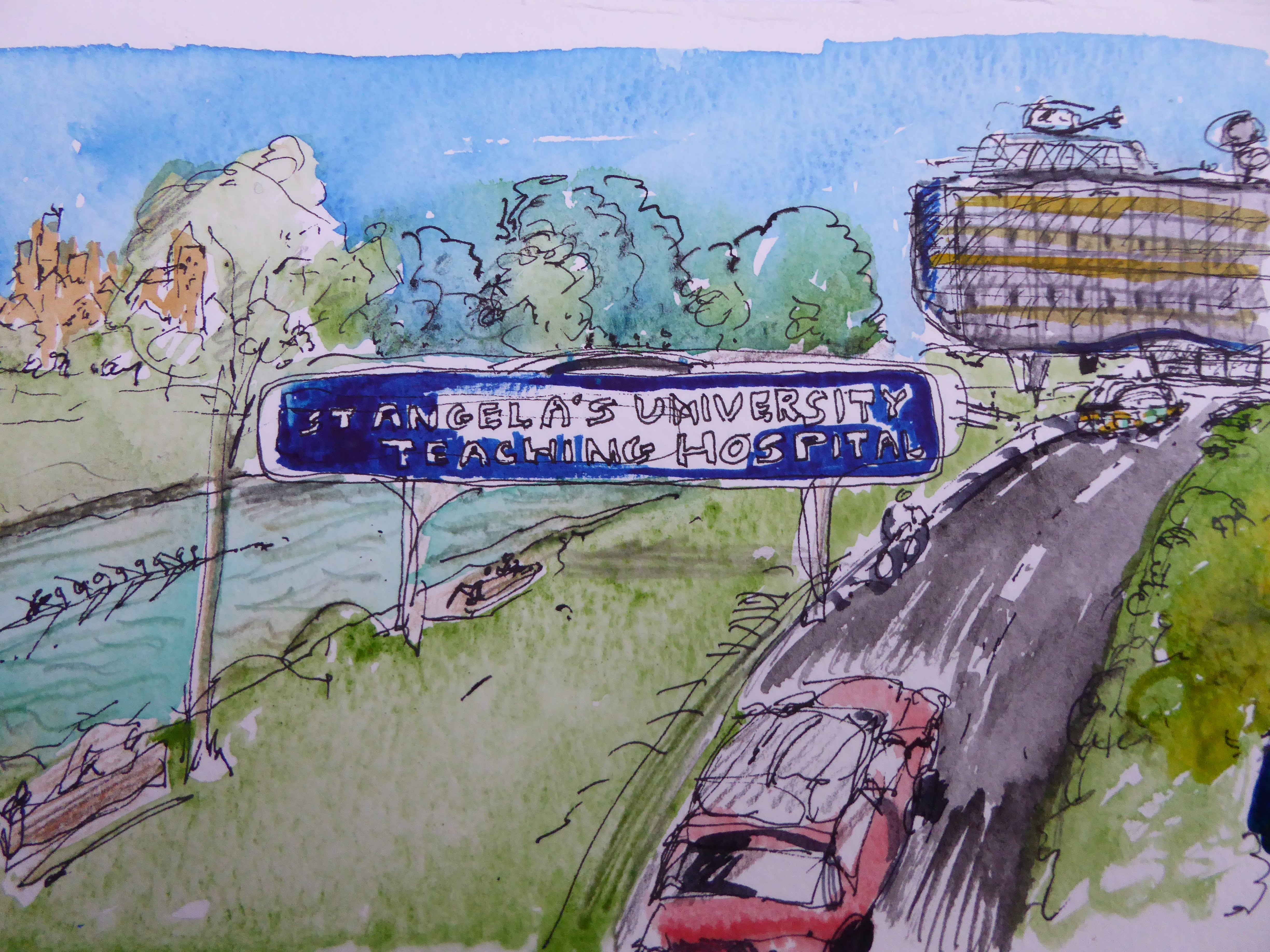
St. Angela’s University Teaching Hospital (illustration by Bill Morris)l
St. Angela’s University Hospital is a prestigious hospital whose complex campus and numerous signs signal its expertise, busyness and status. It clearly cares for people – its patients, and its staff – the professionals. Peeping behind the curtain, with educated eyes, you can see the competing fiefdoms, the power barons, the rising, and falling, stars. If you are really tuned in, you can see how the gangs mark out their turfs and communicate their place in the implicitly understood but not written down hierarchy of power.
Duncan McNiel, the planning director, was by all accounts a “top-man”. He was very experienced, and he was consulted by national players who valued his advice. Indeed as an executive director, he had an office on the all important executive top floor. He had a big window, a sign of status, looking out onto the campus, and beyond to the city’s wide river where the university’s rowing teams would practise in all weathers. His secretary and personal assistant, Amy, was one of those ever-present but melting into the background women. She was, unbeknown to most, quite a dab hand at the computer. She had been to night classes to learn about the new-fangled machines and what they could do. It also had a messaging device, emails, but no-one used it as it was new and a hassle.
Planning was a big frenetic enterprise involving much busyness to collect mostly non-existent data, although much information lay about the place. The planning team, and its eager minions, scurried about constantly looking for data and ideas to develop a strategy that The Commander could “sell” to St. Angela’s all-powerful clinicians. There is organisational power and then there is expert power, as the Prof used to say, and St. Angela’s had the latter in spades.
“Team-building”
This feeling of busyness, frenetic activity, wheels constantly spinning, pervaded everything, even, in retrospect, my pathetic attempt to conduct the team-building diagnostic interviews. Mr. McNiel was very busy, and certainly too busy to talk to me about team-building. After a cursory nod, he suggested I deal with his deputy who was by all accounts a very capable person, and a recent personal appointment. This brush-off was the first of many such experiences that became my “norm”. I understood his position, after all he had been given a tough extra area of responsibility by The Commander– to introduce a computerised new planning system. This involved much important work and was wholly consuming. No problem. His deputy would be fine for my rather modest purposes.
Robert MacCawdor, the deputy, was an equally impressive man. He had been a senior planner in another part of the public service and had set-up what he called his “private office” in the style of senior civil servants and politicians. His “private office” consisted of his secretary, May – another one of those melting into the wall women, and his two personally appointed “special projects” officers, Liz Fenway and Jean Howell. He had inherited three very capable team leaders: Alex McLeod, Alistair Stewart and Carl Roberts. Their jobs formed the three-legged stool upon which Robert MacCawdor’s reputation rested. The wall chart in the planning department on the 1st floor said it all:
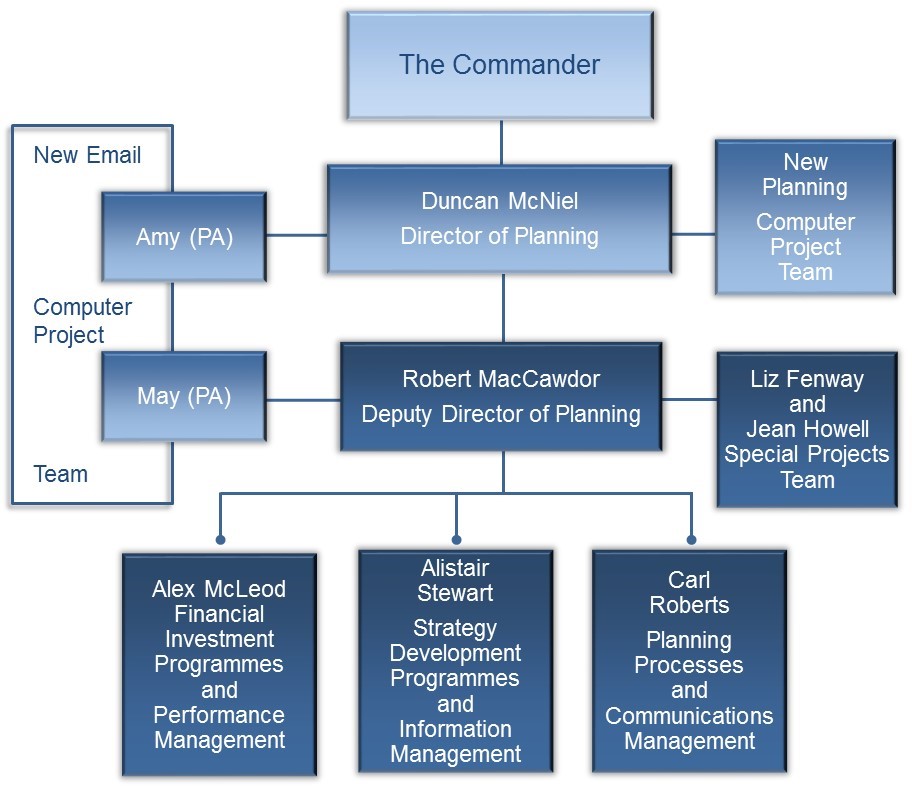
“Team-building” was a big yawn to everyone. They participated under orders. Mr. MacCawdor allowed me to proceed as long as I did not interfere in any of their important work. Frankly, no-one had any time for what they viewed as nonsense work.
The Game of Collusion
The meetings to identify the problems and design a development programme set the
pattern for future events. I learnt quickly that conscripted people turned up to meetings late, if at all; left early, especially if it was a nice sunny day; and did their post in front of everyone. They felt free to stroll in and out to take their calls on the newly introduced mobile phones. I got used to this pattern of them tuning in and out, and I comforted myself in the knowledge that I still got paid no matter who turned up.
And so it went on, these power plays and games of charades where lots of coffee and biscuits got consumed as we pretended to be making progress, and we sent lots of positive messages to the bosses. There was collusion. The Commander was pleased. Sue was pleased. Mr. NcNiel and Mr. MacCawdor were pleased.
 I had that sinking feeling. I was overwhelmed and out of my depth. It was a far cry from my PhD party with the books and champagne novelty cakes. I was young then, and enthusiastic. I modelled myself on the Prof thinking this would get me a big Mercedes one day. I often wondered how he coped with such rude behaviours. Although I used to see him for tea now and then, I never asked as we all colluded in the game of being a success.
He’s Gone
One day, while en-route to meet the conscripted, I was told in a rushed conversation in the corridor with Sue that Duncan had been moved to “special projects”. He was gone. I never saw him again. There were mutterings amongst the minions about the computer project going wrong but nobody senior said a word, not a whisper. Robert MacCawdor had moved into Duncan’s top floor office with the big window and May, his faithful servant, guarded access to him in the outer office.
Amy, Duncan’s PA, on her return from lunch was greeted with the news of the changes. It was that sudden. She was redundant. She packed her things and said goodbye to anyone who would listen, and while they were all out to tea, she wiped all the hard drives clean and went home to the rest of her life.
“Team-building” – it got worse.
Come back next time for Part 2 — The Vanishing of the Lieutenants …
This is a work of fiction. Names, characters, businesses, places, events and incidents are either the products of the author’s imagination or used in a fictitious manner. Any resemblance to actual persons, living or dead, or actual events is purely coincidental.
 Old Lady by the Sea
Fascinating, Annie! A world I wot not of… As well as “Macbeth”, another old story comes to mind – ” The Emperor”s new clothes”…
LikeLike
Loved the professors
advice “go behind the curtain… Front stage /back stage” how very true.
LikeLike